 EN

What Enterprise Buyers Actually Need From a Full Finger Splint
Procurement for a hospital network, an occupational health provider, or a medical distributor looks nothing like a single clinician picking a splint off a shelf. The stakes are different. A single bad unit is a complaint. A bad production run is a recall, a contract review, and a lot of explaining to people who do not want to hear it. That is why the conversation around the full finger splint shifts when enterprises get involved. The questions stop being about one patient and start being about consistency, documentation, and whether the thousandth unit behaves like the first.
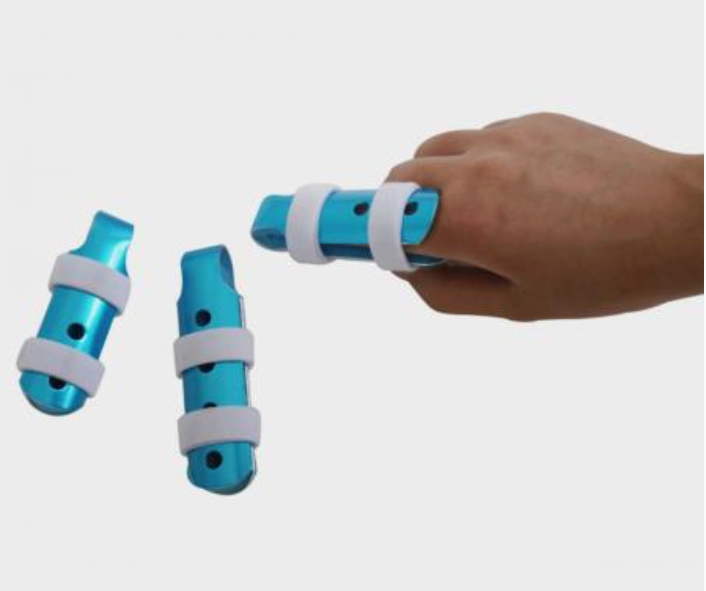
The term itself is broad. A full finger splint generally covers the entire digit, from the metacarpophalangeal joint down past the distal interphalangeal joint, immobilizing the whole finger rather than a single segment. Within that definition, designs vary widely, and those variations matter far more at scale than they do in a single clinic.
Design Architectures and Where They Diverge
Most full finger splints on the market today fall into a handful of structural approaches, and each carries different implications for manufacturing, fitting, and clinical use.
-
Dorsal shell designs: A rigid shell sits over the back of the finger, with straps or wraps securing it. Simple to mold, easy to produce at volume, but fit tolerance is tight because the shell does not conform to individual anatomy.
-
Wrap-around designs: The splint encircles the finger with a semi-rigid material, often foam-backed. Better comfort, but the closure mechanism becomes a weak point over repeated use.
-
Articulated designs: Some units allow controlled motion at specific joints while blocking others. Useful for early mobilization protocols, but the added hardware increases cost and failure points.
-
Composite sandwich designs: Multiple material layers bonded together, tuned for stiffness in one direction and flexibility in another. The most engineering-intensive option, and the hardest to keep consistent across batches.
A common enterprise mistake is treating these as interchangeable based on unit price. The cheaper dorsal shell may cost less per piece, but if it generates a higher return rate because of fit complaints, the true cost per successfully used splint climbs fast.
Material and Manufacturing Consistency: The Hidden Cost Driver
At enterprise volume, material consistency is where budgets quietly break. Two batches of the same thermoplastic can differ in softening temperature, flow behavior, and post-cooling rigidity depending on supplier resin lots. A clinic will never notice. A production line running ten thousand units will.
Three variables tend to drive inconsistency:
-
Resin lot variation: Small differences in polymer grade shift the molding window and final stiffness.
-
Mold wear: Over thousands of cycles, tooling edges round off, and part dimensions drift.
-
Cooling and annealing control: Rushed cooling introduces internal stress that shows up later as warping or cracking.
This is not theoretical. During a supply audit for a rehabilitation equipment distributor in the Midwest, a batch of full finger splints passed incoming inspection but failed in the field three weeks later, with reports of the splints softening in warm transport conditions. The root cause traced back to a resin substitution made without updating the process parameters. The design was fine. The process control was not.
| Model Type | Typical Material | Production Complexity | Fit Consistency | Relative Unit Cost |
|---|---|---|---|---|
| Dorsal shell | Rigid thermoplastic | Low | Medium | Low |
| Wrap-around | Foam-backed composite | Medium | High | Medium |
| Articulated | Thermoplastic with hardware | High | Medium | High |
| Composite sandwich | Multi-layer bonded | High | High | High |
| Custom-molded | Low-temp thermoplastic | Low volume | Very High | High |
The table above is not a ranking of quality. It maps the trade-offs an enterprise has to weigh between per-unit cost, production complexity, and how reliably the product performs across a large population of users.
Standards, Testing, and What Documentation Enterprises Should Demand
Regulatory expectations for medical protective equipment vary by market, but a few things are near-universal. Enterprises buying at scale should expect, at minimum, material traceability, batch-level dimensional records, and some form of mechanical testing data on stiffness and fatigue.
Relevant references worth knowing include ISO 13485 for quality management systems in medical devices, and ASTM standards covering thermoplastic material properties and flexural fatigue. A supplier that cannot produce test data on flexural fatigue is a supplier that has not stress-tested the failure mode that matters most for a splint, which is repeated bending under load.
It is also worth being honest about limits. No splint design eliminates the risk of skin irritation or joint stiffness entirely. Those outcomes depend heavily on wear duration, patient adherence, and follow-up. A well-made splint reduces the probability of mechanical failure. It does not replace clinical judgment.
Sourcing Considerations for Multi-Site Operations
For enterprises running multiple facilities or distributing across regions, the sourcing decision is a supply chain decision as much as a product one.
-
Confirm the supplier maintains tooling for the specific geometry, not just a catalog listing.
-
Ask about batch traceability from raw material to finished unit.
-
Test samples from at least two production runs, not one pilot batch.
-
Check lead times under peak demand, not just standard conditions.
-
Review how the supplier handles a non-conforming batch, because it will happen eventually.
Multi-site operations also need to think about sizing coverage. A single size rarely fits an adult population well, and a splint that is slightly too loose at one site may be reported as a clinical problem rather than a sizing gap.
Where Manufacturing Depth Changes the Equation
The difference between a supplier and a manufacturing partner shows up when something goes wrong or when demand spikes. Onebrace, a medical protective equipment manufacturer, backs its product lines with a research and development team averaging eight years of specialized experience, which shortens the loop between a reported issue and a resolved one. The company runs 12 complete production lines and maintains a library of more than 1,000 mold designs, with monthly output above one million sets. For enterprise buyers, that combination means existing tooling for many splint geometries and the capacity to absorb demand swings without stretching lead times.
Choosing a full finger splint model at enterprise scale comes down to matching design architecture to clinical need, then verifying that the manufacturer can hold that design consistent across thousands of units. Price matters, but consistency is what keeps contracts intact.
Table of Contents
- What Enterprise Buyers Actually Need From a Full Finger Splint
- Design Architectures and Where They Diverge
- Material and Manufacturing Consistency: The Hidden Cost Driver
- Standards, Testing, and What Documentation Enterprises Should Demand
- Sourcing Considerations for Multi-Site Operations
- Where Manufacturing Depth Changes the Equation