 EN

When Knee Support Needs to Do More Than Stabilize
Knee osteoarthritis (OA) can affect how people walk, climb stairs, and manage everyday activities. For individuals with unicompartmental knee OA, the distribution of load across the joint is an important consideration when selecting an appropriate support solution.
This is where an offloading knee brace differs from a conventional knee sleeve. Rather than focusing primarily on compression or general support, an OA unloader brace is designed to apply corrective forces that help redistribute load away from the affected compartment.
For orthopedic brands, distributors, and rehabilitation product suppliers, understanding the mechanics behind an offloading knee brace is essential when evaluating products for a professional portfolio.
What Is a Butterfly Offloading Knee Brace?
A butterfly offloading knee brace is a specialized orthopedic brace designed to support selected cases of unicompartmental knee osteoarthritis.
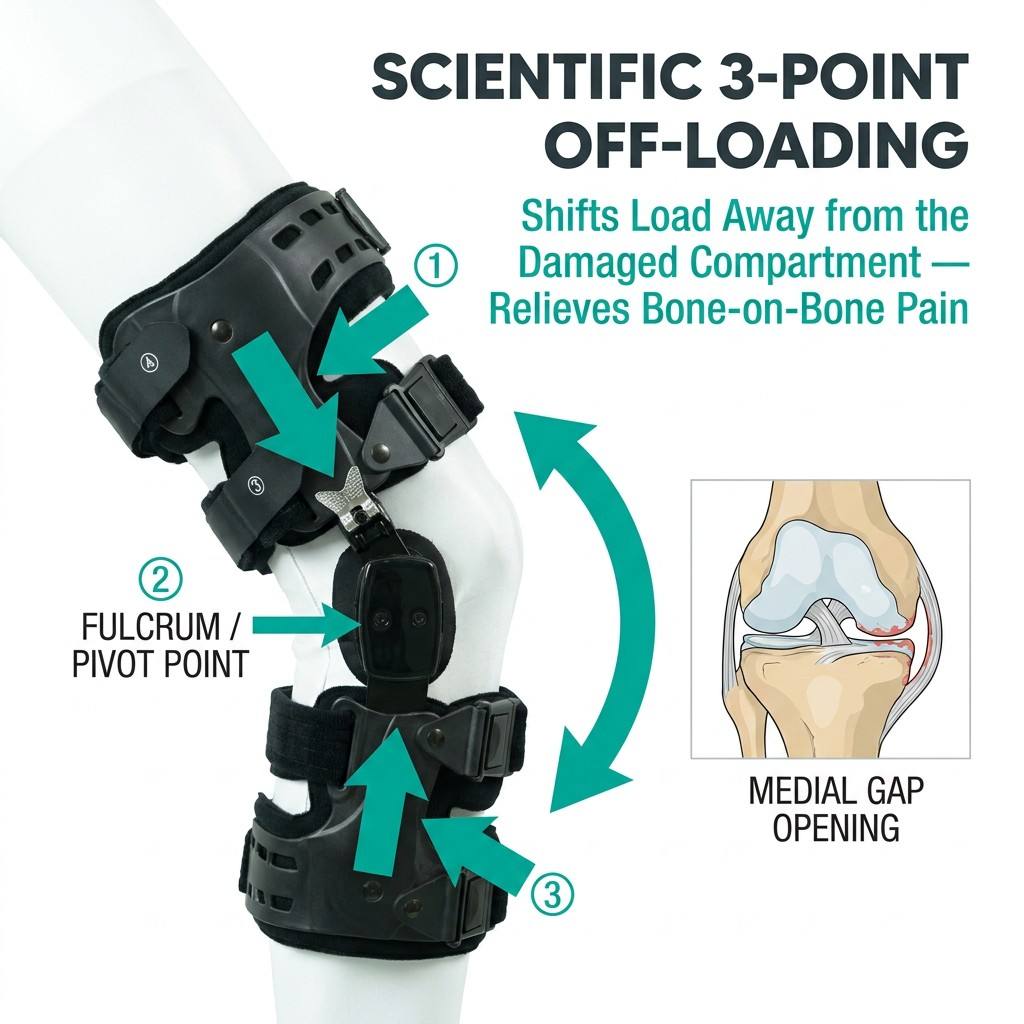
Its defining feature is the butterfly-shaped adjustment mechanism, which allows the unloading force to be adjusted incrementally. Combined with a single-hinge, three-point leverage system, the design aims to help shift load away from the affected medial or lateral compartment.
The intended effect depends on correct fitting, adjustment, and clinical suitability. An offloading brace is not a universal solution for every type or stage of knee OA, and product selection should follow professional assessment.
How Does the Offloading Mechanism Work?
The Three-Point Leverage Principle
A three-point leverage system applies forces at strategically positioned points around the knee. In an unloader brace, this arrangement is designed to create a corrective moment that helps redistribute load between the medial and lateral compartments.
The direction of adjustment depends on which compartment is affected. Varus and valgus configurations are relevant to different unloading objectives, so correct product orientation and fitting are important.
Incremental Adjustment
The butterfly-shaped zinc-alloy adjuster provides a way to fine-tune the unloading setting.
For users and healthcare professionals, controlled adjustment can be useful when evaluating brace alignment and fit. For product developers, the adjustment mechanism is also an important design feature because it influences usability, mechanical performance, and product differentiation.
Any adjustment should follow the manufacturer's instructions and the guidance of a qualified healthcare professional.
Key Design Features That Matter
Anodized Aluminum Alloy Frame
The aluminum alloy uprights provide the structural framework for the brace. Frame geometry, rigidity, and overall fit influence how the brace supports the knee and maintains its intended position.
For buyers, consistency in frame construction and finishing is worth reviewing during sample evaluation.
High-Elasticity EVA Padding
EVA pads provide cushioning at the contact points between the brace and the body. The product combines these pads with a soft velvet and cotton lining.
Padding shape, placement, and material quality can influence the wearing experience, particularly when the brace is used during daily activities.
Numbered Quick-Release Straps
The brace features numbered straps with quick-release buckles. Numbering can help users follow a consistent fastening sequence, while the buckle system supports application and removal.
When evaluating an orthopedic brace, purchasing teams should consider strap durability, fastening reliability, and ease of adjustment.
Left and Right Configurations
The product is available in left- and right-specific configurations. Correct orientation is important because the intended unloading direction must correspond to the affected compartment and the brace's design.
Who May Benefit From an OA Unloader Brace?
Offloading knee braces are commonly considered for selected individuals with mild to moderate unicompartmental knee osteoarthritis. They may also be evaluated in cases involving compartment-specific degenerative changes or certain forms of knee instability.
However, suitability varies with joint alignment, disease severity, anatomy, activity level, and other clinical factors. An offloader brace should not be presented as a substitute for comprehensive OA management or as a guaranteed method of relieving pain.
For distributors, understanding the intended application helps distinguish an OA unloader brace from a general compression sleeve or a postoperative range-of-motion knee brace.
What Should Buyers Look for When Sourcing an Offloading Knee Brace?
For orthopedic brands and medical device distributors, evaluating an OA unloader involves both mechanical design and manufacturing quality.
-
Adjustment mechanism: Review the range and consistency of unloading adjustments.
-
Frame construction: Check material specifications, structural finish, and assembly quality.
-
Padding and straps: Evaluate comfort-related design, fastening durability, and ease of application.
-
Left/right options: Confirm the available configurations and product identification.
-
Quality control: Ask about component inspection, assembly checks, and finished-product consistency.
-
OEM/ODM requirements: Discuss logos, packaging, labeling, sample evaluation, and any requested customization before production.
A product sample allows purchasing teams to assess construction and usability against their own requirements before committing to a larger order.
The Huakang Butterfly Offloading Knee Brace
Xiamen Huakang Orthopedic's Butterfly Offloading Knee Brace combines a butterfly-shaped zinc-alloy adjuster with an anodized aluminum alloy frame and a single-hinge, three-point leverage system.
Additional design features include high-elasticity EVA pads, a velvet and cotton lining, numbered quick-release buckle straps, and left/right-specific configurations.
These features make the product relevant for orthopedic brands and distributors evaluating adjustable OA unloader braces for their product portfolios.
For technical specifications, available configurations, and customization details, buyers should refer to the product page and confirm requirements directly with the manufacturer.
Looking for an OA Unloader Knee Brace Manufacturer?
Choosing an orthopedic brace supplier involves more than comparing product appearance. Consistent construction, clear specifications, dependable quality control, and responsive OEM/ODM communication all contribute to a reliable sourcing relationship.
If you are an orthopedic brand owner, medical device distributor, or rehabilitation product supplier looking to expand your knee brace range, Xiamen Huakang Orthopedic welcomes inquiries about the Butterfly Offloading Knee Brace.
Contact our team to discuss product specifications, samples, packaging, and private-label requirements.
Explore our Butterfly Offloading Knee Brace for more product details.
Disclaimer: This article is intended for general product and industry information only. It does not replace professional medical advice. Brace selection, fitting, and adjustment should follow the guidance of a qualified healthcare professional.
Table of Contents
- When Knee Support Needs to Do More Than Stabilize
- What Is a Butterfly Offloading Knee Brace?
- How Does the Offloading Mechanism Work?
- Key Design Features That Matter
- Who May Benefit From an OA Unloader Brace?
- What Should Buyers Look for When Sourcing an Offloading Knee Brace?
- The Huakang Butterfly Offloading Knee Brace
- Looking for an OA Unloader Knee Brace Manufacturer?