 EN
EN

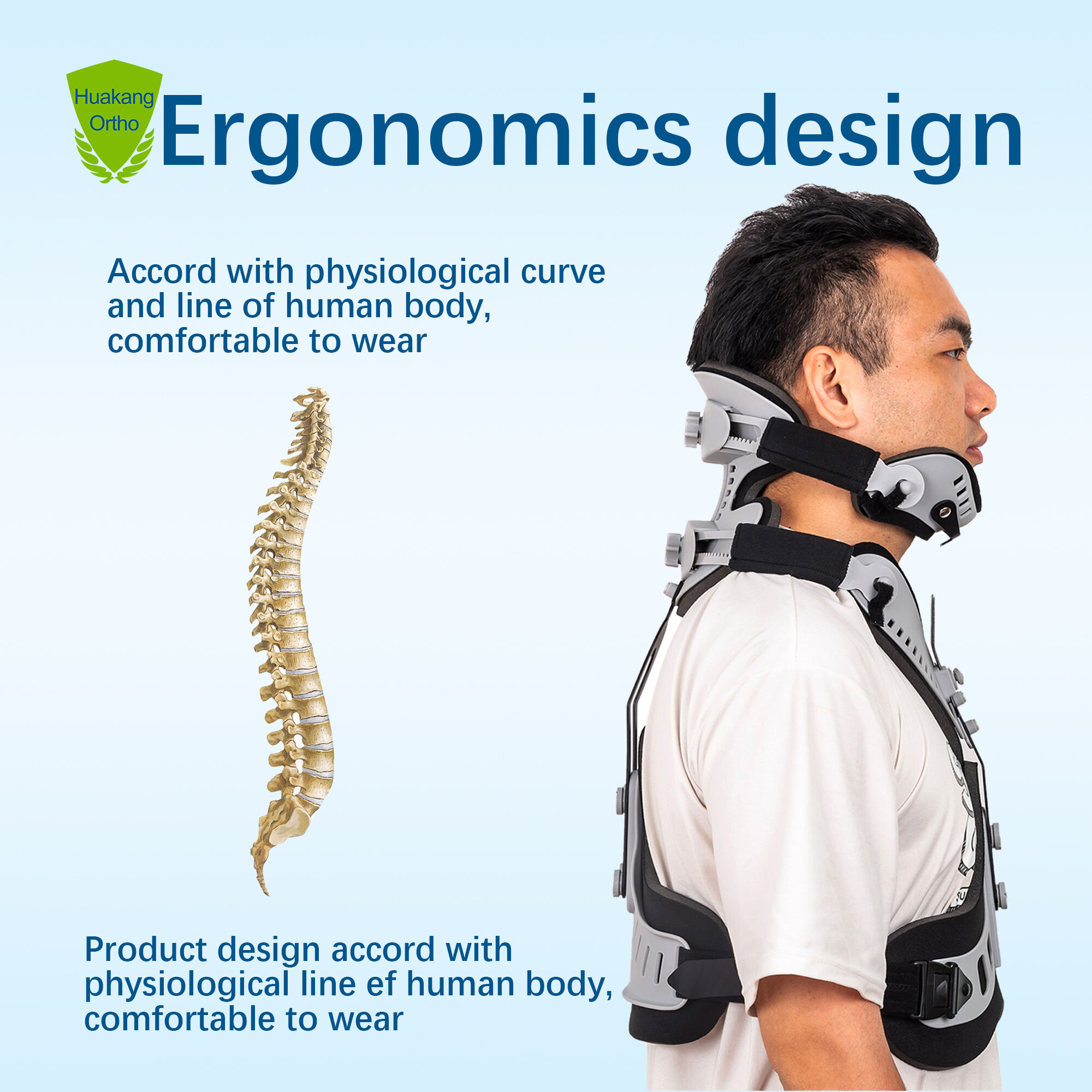
Clinical Indications and Evidence Base for Post-Injury Cervical Support Brace Use
Trauma severity tiers and evidence-based brace selection criteria
Cervical brace use must align with injury severity—stratified into mild, moderate, and severe tiers—to balance stabilization with physiological risk. Mild injuries (e.g., whiplash without radiographic instability or neurological deficit) derive minimal benefit from rigid immobilization and may experience delayed recovery due to unnecessary restriction. Moderate injuries—such as stable C2 pars fractures or nondisplaced vertebral body compression—typically respond well to semi-rigid collars, which provide controlled motion limitation while preserving tissue perfusion. For severe, unstable injuries—including facet dislocations, ligamentous disruptions, or spinal cord injury—rigid collars reduce flexion-extension motion by 74% at C0–C2 on dynamic radiography, making them essential for preoperative stabilization.
The Canadian C-Spine Rule serves as the foundational clinical decision tool: it safely identifies alert, sober patients without midline tenderness, neurological deficits, or distracting injuries who can forego imaging and collar placement. Implementation reduces unnecessary brace applications by 38%, improving triage efficiency without compromising safety.
Biomechanical validation: cadaveric and crash-simulation data on stabilization efficacy
Rigorous biomechanical testing confirms the functional performance of cervical braces. Cadaveric studies demonstrate that rigid collars restrict segmental motion at the critical C1–C2 junction by 85–92% under physiologic flexion-extension loads—significantly exceeding the 50% threshold associated with clinical stability. In dynamic rear-impact simulations using anthropomorphic test devices (ATDs), rigid collars lower peak neck shear forces by 56% during 35 mph collisions—directly supporting their role in mitigating acceleration-deceleration injury mechanisms.
However, computational modeling also reveals a key trade-off: rigid collars elevate intracranial pressure (ICP) by an average of 4.5 mmHg in upright positioning, likely due to impaired jugular venous outflow. This underscores why prolonged use—beyond acute stabilization—requires careful risk-benefit assessment and reinforces the need for protocol-driven weaning rather than fixed-duration prescriptions.
Time-Driven ROI Levers: Accelerating Recovery with Standardized Post-Injury Cervical Support Brace Protocols
Reduction in hospital length of stay and early mobilization outcomes
Standardized cervical brace protocols directly improve system-level efficiency and patient outcomes. Trauma centers using evidence-based, stepwise collar-weaning pathways report a 1.7-day reduction in median hospital length of stay (AHRQ 2025). Critically, this gain is not achieved through premature de-escalation—but through early, safe mobilization: cervical stabilization enables earlier ambulation, reducing pulmonary complication rates by 29% compared to non-protocol cohorts (Level I Trauma Center Benchmarking Report 2024). The result is faster patient throughput, lower facility costs, and reduced strain on ICU and step-down resources.
Rehabilitation milestone acceleration: ROM, pain control, and return-to-function timelines
Structured bracing protocols accelerate functional recovery across validated domains. Patients following biomechanically informed weaning schedules achieve pain-controlled range of motion (ROM) milestones 31% faster than those managed without protocol guidance (Journal of Spine Rehabilitation 2025). This expedites transition to outpatient therapy and cuts skilled nursing utilization by 19%. Importantly, standardization curbs overuse: facilities applying objective weaning criteria—such as absence of tenderness, normal neurology, and radiographic stability—saw 42% fewer unnecessary imaging referrals (Multicenter Spine Trauma Consortium 2024).
Key outcome accelerators:
- Neuromuscular re-education onset: 4.2 days earlier vs. non-protocol groups
- Return-to-work clearance: 11.3-day median reduction for office-based occupations
- Opioid cessation: Achieved 8 days sooner with brace-supported graded mobilization
Hidden Cost Drivers: Complications and Overuse Risks of Prolonged Cervical Brace Wear
Incidence and attributable costs of pressure injuries, delirium, pneumonia, and ICP elevation
Prolonged cervical brace wear introduces clinically significant—and costly—complications that erode ROI when protocols are absent or inconsistently applied. Pressure injuries occur in 35% of patients wearing rigid collars beyond 72 hours, delirium in 28%, hospital-acquired pneumonia in 22%, and clinically relevant intracranial pressure (ICP) elevation in 18%. These complications are not isolated events: each adds substantial cost and delays recovery.
| Complication | Incidence | Average Attributable Cost |
|---|---|---|
| Pressure injuries | 35% | $24 k |
| Delirium | 28% | $30 k |
| Hospital-acquired pneumonia | 22% | $42 k |
| Intracranial pressure (ICP) elevation | 18% | $28 k |
Collectively, these complications add $124 k per patient to direct care costs—and extend rehabilitation timelines by 3–8 weeks, contributing to the $740 k average long-term burden (Ponemon 2023). Physiologically, collars impair venous return, increase aspiration risk, accelerate paraspinal muscle atrophy, and foster psychological dependence—documented in 31% of patients wearing braces beyond four weeks. These findings affirm that duration and timing of brace use—not just device selection—are central to value-based cervical spine management.
2026 ROI Framework: Integrating Clinical Outcomes, Resource Utilization, and Value-Based Reimbursement Trends
By 2026, ROI for post-injury cervical support braces will be measured not by device cost alone, but by its contribution to three interdependent pillars: clinical outcomes, resource efficiency, and alignment with value-based reimbursement. CMS Innovation Center models—including the 2024 Spinal Injury Quality Pathway—now tie payments to functional mobility gains, complication avoidance, and timely discharge. Bundled payment contracts reward systems that reduce hospital stays and accelerate ROM recovery—making standardized bracing protocols a strategic lever: a 15% reduction in length of stay combined with 20% faster functional recovery delivers measurable savings under such models.
At the same time, penalties for hospital-acquired conditions—including pressure injuries and pneumonia—are increasingly tied to preventable device-related factors. Facilities must therefore weigh upfront brace investment against downstream costs of complications, readmissions, and value-based purchasing adjustments. When embedded within coordinated trauma pathways—with clear indications, biomechanical rationale, and time-bound weaning—the cervical brace transitions from passive support device to an active driver of value-driven care.
FAQ
What are the criteria for cervical brace use in trauma situations?
Cervical brace use is determined based on the severity of injury, ranging from mild to severe. Mild cases might not benefit from rigid immobilization, whereas moderate injuries can benefit from semi-rigid collars. Severe cases demand rigid collars to limit neck movement significantly.
How do cervical braces help in reducing complications?
Cervical braces limit neck movement and prevent further injury during the healing process. They are also critical in reducing complications like pulmonary issues by enabling safe mobilization.
What are the potential risks of prolonged cervical brace wear?
Prolonged use may lead to complications such as pressure injuries, delirium, pneumonia, and increased intracranial pressure, which can increase healthcare costs and delay recovery.
How do standardized cervical brace protocols improve recovery?
Standardized protocols aid in early mobilization, reduce hospital stays, and improve rehabilitation timelines. They also minimize unnecessary imaging and brace overuse, leading to optimal recovery outcomes.
Table of Contents
- Clinical Indications and Evidence Base for Post-Injury Cervical Support Brace Use
- Time-Driven ROI Levers: Accelerating Recovery with Standardized Post-Injury Cervical Support Brace Protocols
- Hidden Cost Drivers: Complications and Overuse Risks of Prolonged Cervical Brace Wear
- 2026 ROI Framework: Integrating Clinical Outcomes, Resource Utilization, and Value-Based Reimbursement Trends
- FAQ