 EN

Three Points of Control, Three Points of Pressure: The Jewett Brace Trade-off
A Jewett brace does not hold the spine up. It stops the torso from bending forward, and it does so with an unusually direct mechanism: two pads in front, one behind, arranged so that the trunk becomes a lever the patient cannot fold.
That distinction matters more than it sounds. Most back braces in a distributor's catalog work by compression — an elastic or semi-rigid corset that squeezes the abdomen, warms the region, and offers general support. A Jewett brace works by leverage. It is a different device with a different indication, a different fitting logic, and a different set of failure modes. When a clinician or a buyer treats it as a heavy-duty back support, the result is a brace that gets fitted wrong, worn badly, and returned.
What the Brace Actually Does
The mechanics are best understood as a three-point system. Two anterior pads — one against the sternum, one above the pubic area — press posteriorly. A single posterior pad, mounted on the frame, presses anteriorly at the spinal level the clinician has chosen. The trunk is caught between these opposing forces.
The result is not rigid immobilization in every direction. It is a controlled restriction of flexion: the patient can still rotate and side-bend to a degree, but the forward fold that loads the anterior vertebral bodies is blocked. In selected cases the arrangement is also used to hold the thoracolumbar spine in a degree of extension, which is where the "hyperextension" in the name comes from.
Because the device works as a lever rather than a wrap, the frame carries real bending load. That is why the structure is metal, why the pads are shaped rather than flat, and why strap tension is not the primary variable in how well it controls the spine. A patient who tightens the straps to feel "more supported" mostly increases pressure on three small areas of skin.
Why the Classic Indication Is the Thoracolumbar Junction
The most familiar use is a stable compression fracture in the thoracolumbar region, commonly described as T10 to L2. In osteoporotic bone, an anterior wedge fracture reduces the front height of a vertebral body and shifts the segment toward kyphosis. Limiting flexion in that segment is a way of protecting the healing body while still allowing the patient to be mobile.
The word that carries the weight here is stable. Fracture stability, neurological status, the degree of vertebral height loss, and whether the patient is a candidate for other interventions are clinical judgments made from imaging and examination. A Jewett brace is not a substitute for that assessment, and unstable injuries, deteriorating neurology, and cases where surgical management is being considered belong in different pathways.
Other published uses include thoracolumbar kyphosis such as Scheuermann's disease, post-operative stabilization of the spinal column, and osteoporosis-related spinal support. Each carries its own protocol, and the wearing schedule is set by the treating clinician, not by the device.
Where the Design Creates Its Own Problems
Three points of control are, unavoidably, three points of pressure. This is the central trade-off in the design, and it drives most of what goes wrong in practice.
Pressure over thin skin. The population that most often needs this brace — older patients with osteoporotic bone — is also the population most vulnerable to pressure injury. Sternal and suprapubic skin is thin, and the posterior pad sits over the spinous processes with very little soft tissue between pad and bone.
Fit level, not fit tightness. The posterior pad has to sit at the level the clinician specified. A frame sized for a longer torso will place that pad a segment too high; too short, and it drops below the target. Either way the lever loads the wrong vertebrae and the patient reports that the brace "does nothing" or "digs in."
Daily life becomes the compliance problem. A device that blocks forward bending interferes with shoes, low chairs, car seats, and mealtimes. The suprapubic pad can press on the abdomen after a large meal. Patients rarely describe these as pain scores; they simply wear the brace less.
Overtightening. Tightening the webbing is the one adjustment a patient can make alone, so it becomes the default response to any discomfort. It does not increase control in proportion, and it does increase pressure.
The Details That Decide Whether a Patient Tolerates It
A frame rigid enough to act as a lever
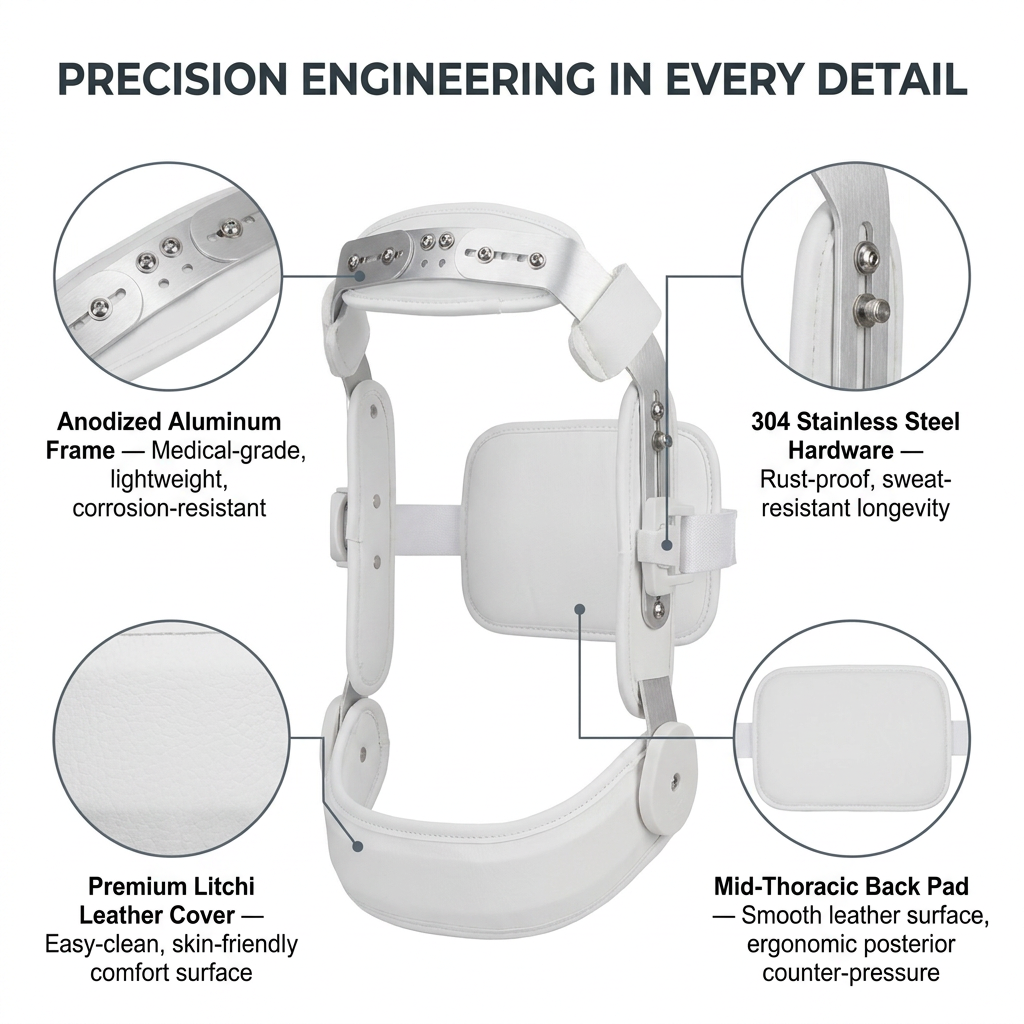
High-strength anodized aluminum alloy gives the structure the rigidity a three-point lever needs without the mass of steel. This matters more than it looks: the brace is worn over a small contact area for weeks, and every gram of frame weight is transmitted through the sternal and suprapubic pads. The anodized finish also gives the frame a cleanable, corrosion-resistant surface, which is relevant for a device that will be wiped down repeatedly.
Pads shaped to anatomy, covered for hygiene
Ergonomically shaped sternal and suprapubic pads spread force over a contoured surface instead of a flat plate. The cover material matters as much as the shape: a litchi-textured leather facing over the pad is wipeable, low-friction against clothing, and it does not hold moisture the way an exposed foam face does. On a device worn against the chest and abdomen, that is a hygiene and shear consideration, not a cosmetic one.
Foam thickness as a specification, not an afterthought
The 0.7 cm high-density PE/EVA padding under the pads is the layer that converts point load into distributed load. Thickness is a genuine engineering number here. Padding that is too thin concentrates pressure at the pad edges; padding that is too soft compresses to nothing over weeks of wear and the lever loses its contact. When buyers compare quotations, foam thickness and density belong in the specification, not in a footnote.
Webbing that holds its setting
White cotton webbing with heavy-duty plastic buckles holds tension predictably, which suits a leverage device better than elastic webbing that creeps and lets the frame drift. Cotton also fails visibly — fraying and stitch failure show up before a strap breaks in use. The buckles need to close and release easily enough for an older patient with limited hand strength to manage unaided; a closure that is secure but stiff produces exactly the quiet non-compliance described above.
Hardware that survives repeated adjustment
304 stainless steel pins and screws at the adjustment points keep the frame from seizing after cleaning and repeated re-fitting. This is a small detail with an outsized effect on returns: a brace that cannot be adjusted smoothly at a follow-up visit tends to be replaced rather than repaired.
What the Brace Cannot Do
It cannot make an unstable fracture stable, and it is not a treatment for neurological deficit. It does not address bone quality; osteoporosis management remains a separate clinical matter. It does not eliminate the need for skin inspection, and it does not fit every body habitus — abdominal contour and torso length both affect whether the three contact points can be established at all.
Two practical limits are worth stating plainly. The posterior pad's position is a clinical decision, so any change to frame size or pad height should be checked rather than improvised. And pressure-related complaints should be reported to the treating clinician rather than solved by loosening or tightening the straps.
What Buyers Should Check Before Adding This SKU
A hyperextension brace is a low-volume, high-specification item. It sells in small quantities relative to a lumbar support, but each unit carries more fitting risk, so the cost of getting the specification wrong is concentrated.
Torso-length sizing and a measurement protocol. Confirm what sizing the supplier offers and how torso length maps to frame length. Without a written measurement method, a distributor's sales team will guess, and the posterior pad will land in the wrong place.
Pad and foam specification on the quotation. Shape, cover material, foam thickness, and foam density should be stated explicitly so that a second quotation can be compared like for like.
Replacement parts and cleaning guidance. Pads, webbing, and buckles are the wear items. Confirm whether they can be supplied separately, and what cleaning method is recommended for leather-faced pads and anodized frames; clinics that can repair a brace keep using it.
Fitting instructions and training material. A one-page fitting and skin-check sheet does more for tolerance and returns than most product changes. If the brace is sold to clinicians, ask what documentation the supplier provides.
Market documentation. Regulatory status is product-, establishment-, and market-specific. Confirm what applies to the exact configuration you order before publishing claims of your own.
Inside the Onebrace Back Support Range
The Jewett hyperextension brace is built on the structure described above: a high-strength anodized aluminum alloy frame, ergonomically shaped sternal and suprapubic pads covered in white litchi leather, 0.7 cm high-density PE/EVA inner padding, white cotton webbing with heavy-duty plastic buckles, and 304 stainless steel pins and screws at the adjustment points. It is designed to provide external support and positional control for the thoracic and lumbar spine.
Published indications cover stable compression fractures in the T10–L2 region, thoracolumbar kyphosis including Scheuermann's disease, post-operative stabilization of the spinal column, and osteoporosis-related spinal support. It sits alongside the wider back support range, which also includes lumbar sacral orthoses and post-operative configurations; for the post-surgical side of that portfolio, our article on post-surgery back bracing essentials covers the TLSO and LSO logic.
Xiamen Huakang Orthopedic has manufactured orthopedic and rehabilitation supports since 2014, operating a facility of approximately 9,000 m² in Xiamen with 12 production lines, annual output above five million units, and exports to more than 40 countries. OEM and ODM work is supported by an in-house technical team of around ten people, which is where questions about frame sizing, pad geometry, foam specification, and private-label packaging are usually resolved.
Specifying a Hyperextension Brace for Your Market?
If you are sourcing a Jewett brace for a distributor range, a hospital or clinic formulary, or a private-label program, our team can work through torso sizing, pad and foam specification, webbing and buckle options, replacement parts, documentation, and OEM requirements with you. Send your specification or request a sample and we will respond with a configuration that fits your market.
This article is intended for healthcare professionals, distributors, and product buyers as general information on device design and sourcing. It is not medical advice, and it does not replace assessment, imaging, or treatment planning by a qualified clinician. Indication, fit level, and wearing schedule must be determined by the treating professional for each patient.
Table of Contents
- Three Points of Control, Three Points of Pressure: The Jewett Brace Trade-off
- What the Brace Actually Does
- Why the Classic Indication Is the Thoracolumbar Junction
- Where the Design Creates Its Own Problems
- The Details That Decide Whether a Patient Tolerates It
- What the Brace Cannot Do
- What Buyers Should Check Before Adding This SKU
- Inside the Onebrace Back Support Range
- Specifying a Hyperextension Brace for Your Market?