 EN

The Closure Is the Variable: How a Dial-System Wrist Brace Changes Fit
Ask what makes a wrist brace work and most people point to the splint. The stay, the shape, the rigidity, the way it holds the wrist at a neutral angle. That is where the engineering conversation usually happens, and it is where product pages put their specifications.
In daily use, the splint rarely fails. The closure does.
A brace that was fitted correctly on a swollen wrist in week one is a different device on the same wrist in week three. The straps that a clinician tensioned with two hands are re-tensioned by a patient with one. The setting that produced the right amount of compression at 9 a.m. is not the setting present at 6 p.m. None of this shows up as a product defect, which is exactly why it goes unaddressed.
Why Strap Tension Drifts
Four mechanisms account for most of the drift, and they compound.
Swelling resolves. Edema peaks in the first days after injury and then subsides. A brace fitted at peak swelling is loose once the swelling drops, and by then the fitting appointment is over. The patient does not re-measure; the brace still feels like it is doing something.
Webbing and closures degrade. Elastic straps lose recovery. Hook-and-loop loses peel strength as lint accumulates and as cycles add up. Neither failure is visible in the way a broken splint is visible.
Application varies. Straps have no reference value. The same patient pulls them differently every morning, and a second person applying the brace produces a third result. This is the difference between an adjustable brace and a brace with reproducible tension — a distinction that matters more than most catalog copy suggests.
The good hand has to do the work. When the injured wrist is the dominant one, the patient closes the brace with the non-dominant hand. Strap-and-buckle systems are awkward one-handed, so patients compensate in the direction that feels safer: they under-tighten. A brace worn loose is not a brace that provides less support. It is a brace that provides unpredictable support.
What a Dial-Lace Closure Changes
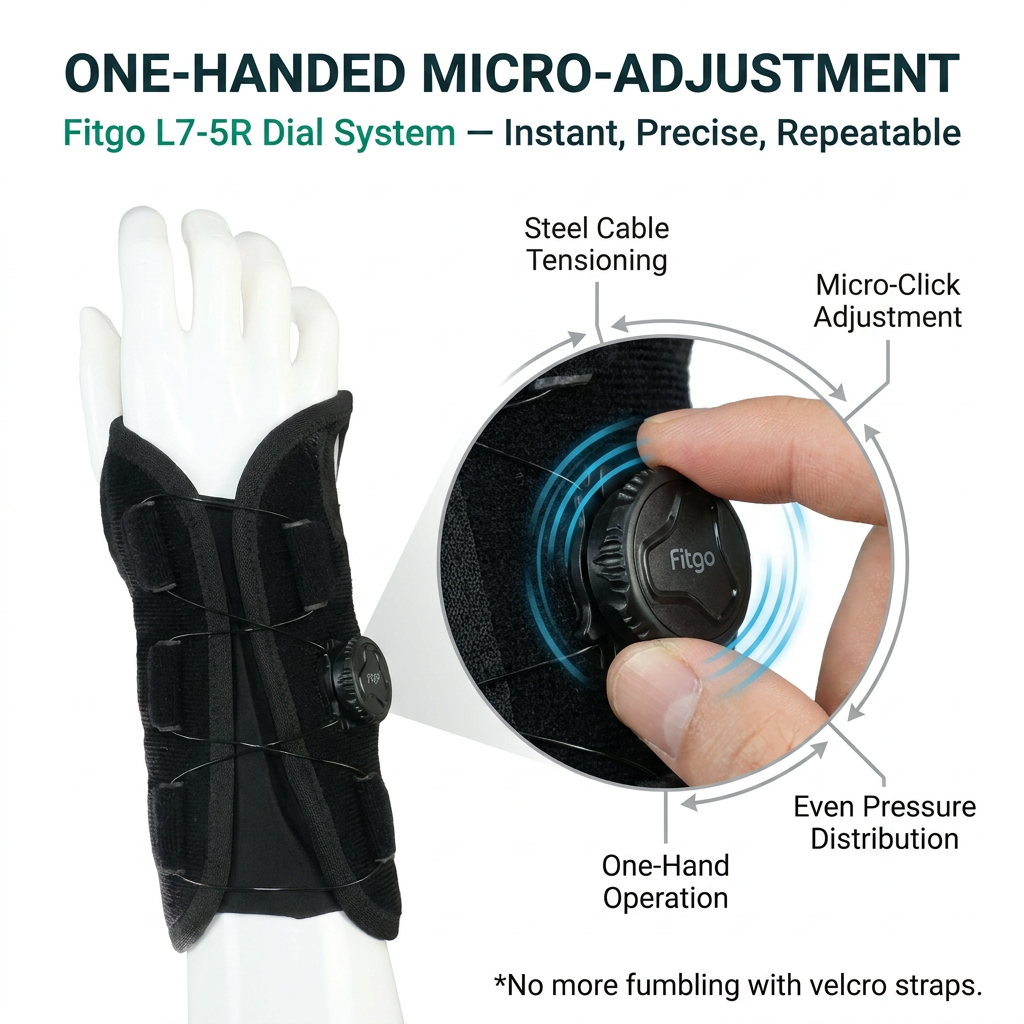
A dial system replaces discrete straps with a continuous cable network under a rotating dial. The design consequence is not simply "easier to tighten" — it changes three things at once.
Tension is distributed rather than localized. Straps load the brace at two or three pull points, and the pressure concentrates under those points and at the strap edges. A cable routed across the shell spreads force along its path, so the same amount of compression is carried by a larger area of the wrist.
The setting is repeatable. A dial holds a position in discrete increments. That gives the patient something a strap cannot: a reference. The brace can be released for washing or for a skin check and then returned to approximately the setting it came from, instead of being re-guessed. For a device worn through a workday, this is the difference between a protocol and an intention.
It can be adjusted one-handed, finely, in the moment. Rotating a dial requires one hand and no alignment. Small increments let a patient accommodate the swelling of a particular day — a little looser in the evening, a little firmer for a shift on their feet — without releasing the whole brace.
None of this makes the closure more important than the splint. It makes the closure the part that determines whether the splint's design ever gets expressed on the wrist.
Where the Trade-offs Sit
A dial system is not a free upgrade, and buyers should hear the costs as clearly as the benefits.
More components, more wear points. A dial, a cable, and cable guides are precision parts. They should be specified with cycle life in mind, and the dial assembly should be serviceable or replaceable rather than turning a brace into a disposable item.
Cable tension concentrates along its path. A cable under load is a line of force. Unless the shell spreads that force, the cable becomes a pressure line rather than a distributed wrap. This is why the layered construction of a dial-system brace matters: the knit shell, the reinforced structure, the rigid strips, and the pre-shaped stay all contribute to load spreading, not just to support.
Sizing becomes more critical, not less. A dial can over-tighten a brace that is too large, and patients will do exactly that to make a loose brace feel secure. A closure with fine adjustment invites compensation for a sizing error. Distribution discipline — measure, stock the full range, do not let a size up substitute for a fit — matters more with this mechanism than with straps.
Cost, and therefore positioning. A dial brace sits in a different price tier than a strap brace. It belongs where the fit story can actually be demonstrated: clinical channels, occupational health programs, and retail environments with staff who can show a customer the dial.
It is the wrong device where uninterrupted rigid immobilization is required. The dial's central advantage is easy, repeatable release. In a protocol that depends on the brace staying exactly as set, that advantage becomes a risk. Post-operative use belongs to the clinician's judgment, and the brace should be specified for it only when the protocol tolerates adjustment.
What Changes for the Clinician
The practical value of a repeatable closure is that it creates a reference point both sides can use. A clinician can set the tension, note the dial position, and hand the patient a number to return to rather than an impression to reproduce.
That also gives the patient a better instruction than "keep it snug": release it for skin care, check the skin, return it to the marked setting, and report pressure or numbness rather than solving it by loosening the brace. Night wear and daytime wear often call for different tensions, and a dial makes that switch a two-second action instead of a re-strapping exercise — which is precisely the kind of friction that determines whether a night-wearing instruction is followed.
Inside the Fitgo Dial System Wrist Brace
The Fitgo dial system wrist brace (https://www.onebrace.net/fitgo-dial-system-wrist-brace) is built around the closure logic above. A genuine Fitgo L7-5R dial drives micro-adjustable compression in place of conventional hook-and-loop straps. The shell combines a high-performance fly-knit outer layer with a reinforced synthetic leather structure, and the lining is 0.2 cm high-density sponge bonded with velvet for a soft contact surface.
Support comes from an anatomically pre-shaped aluminum splint — removable — together with rigid PP strips. The brace is available in S, M, L, and XL and fits either hand, which simplifies both fitting and inventory in a clinic or a retail range. Custom colors are available under OEM/ODM, and the same construction is available across the wider wrist brace range (https://www.onebrace.net/wrist-brace) for buyers assembling a full category rather than a single SKU.
Xiamen Huakang Orthopedic has manufactured orthopedic and rehabilitation supports since 2014, operating a facility of approximately 9,000 m² in Xiamen with 12 production lines, annual output above five million units, and exports to more than 40 countries. OEM and ODM work is supported by an in-house technical team of around ten people, which is where questions about shell construction, dial and cable specification, color programs, and packaging are usually resolved.
Sourcing a Dial-System Wrist Brace?
If the mechanism fits your range, the useful conversation is about specification rather than price alone: which dial and cable system, what cycle life has been validated, how the shell spreads cable load, what sizing range your market needs, and what packaging and instruction material ship with the brace. Send your requirements or request a sample (https://www.onebrace.net/contact-us) and we will respond with a configuration that suits your channel.
This article is intended for healthcare professionals, distributors, and product buyers as general information on device design and sourcing. It is not medical advice and does not replace assessment or treatment planning by a qualified clinician. Indication, wearing schedule, and tension settings must be determined by the treating professional for each patient.