 EN

Beyond the Eight-Week Rule: Why Mallet Finger Splint Design Decides Compliance
Ask a hand therapist what decides the outcome of a mallet finger, and the answer rarely begins with the splint. It begins with whether the splint stayed on.
Closed mallet finger injuries are commonly managed with the distal interphalangeal (DIP) joint held in extension for roughly six to eight weeks, with some protocols extending night wear further. The schedule depends on the injury and the treating clinician. The principle does not: the joint must stay extended, continuously, for the terminal extensor tendon to heal at a functional length. A splint removed twice a day for practical reasons is not a slightly weaker version of the same treatment. It is a different treatment.
That places an unusual burden on a small device. It has to hold a joint in a precise position for weeks, against sweat, swelling, handwashing, sleep, and the ordinary impatience of wearing something on a working hand.
Why Continuous Extension, Not Just Extension, Is the Point
The DIP joint is stabilized by the terminal extensor tendon. When that tendon is disrupted — usually by forced flexion of an extended fingertip — it heals into scar tissue whose length is set by the position the joint occupies during the healing window. Held in extension, the tissue reconnects at a length that later allows active extension. Allowed to flex repeatedly, the immature repair is loaded in a direction it cannot yet tolerate.
This is why guidance on mallet finger splinting is unusually strict about uninterrupted wear, and why patients are often taught to keep the fingertip supported even while cleaning the skin beneath the splint. The risk is rarely one dramatic event. It is the accumulation of small moments: a splint slid off to wash hands, a finger flexed to reach a seatbelt, a device removed at night because it pressed against the mattress.
Where Mallet Finger Protocols Break Down
Three failure points account for most of the practical difficulty, and none of them is a diagnostic problem.
Momentary removal. Every re-application is a chance to flex the joint, and a splint that is awkward to close one-handed raises that chance.
Pressure and moisture. Weeks of continuous skin contact is a long exposure. Maceration and localized pressure are among the most frequently reported problems with prolonged splinting, and the most common reason a patient decides to "give the finger some air."
Bulk. A splint that interferes with typing, gloves, or sleep is rarely reported as a problem. It is quietly removed.
All three are design and instruction issues — and the ground on which a considered splint separates itself from a strip of metal.
The Design Details That Keep a Splint On
A core that bends to the finger
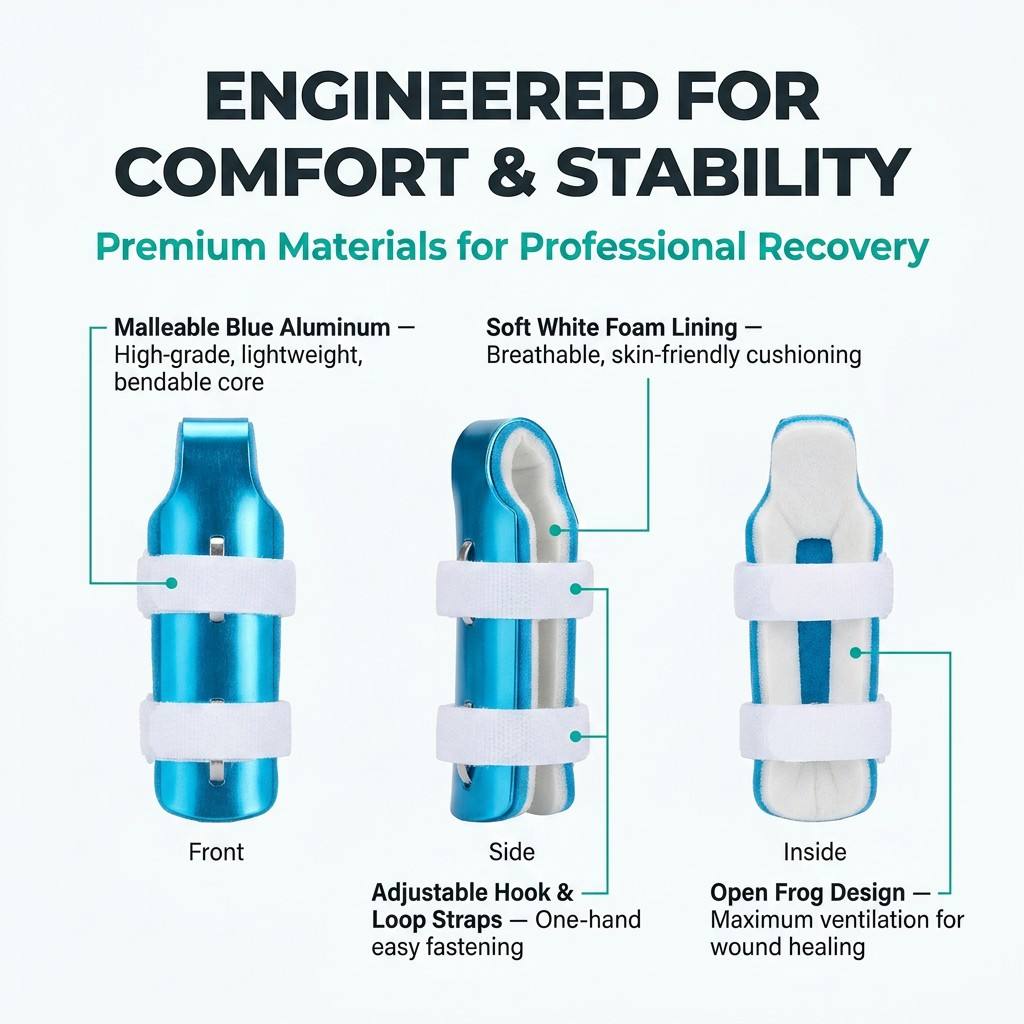
A malleable aluminum alloy core lets the splint be shaped to the individual finger instead of forcing the finger into a fixed channel. The practical gain is three-point control: contact at the proximal phalanx, the middle phalanx, and the distal segment, so the DIP joint is held in position without concentrating pressure in one place.
Malleability also answers a detail that is easy to overlook: swelling changes. A splint fitted on day one may be loose by day ten, and being able to re-bend the frame — sparingly — keeps the fit close as edema settles.
The trade-off is worth stating. Aluminum fatigues where it is repeatedly bent at one point, so the splint should be set carefully once and adjusted rarely. Re-bendability is a fitting convenience, not a substitute for correct initial sizing, and buyers comparing aluminum with thermoplastic should treat it that way.
Foam against skin, air around the frame
Soft breathable foam padding manages shear and pressure where the splint meets skin. The open "frog" frame serves a different purpose: it lets a clinician or patient inspect the skin and nail bed without removing the device, and lets air reach the areas that stay damp under a closed design. On something worn for weeks, ventilation is not a comfort feature. It is a compliance feature.
Two straps doing two different jobs
One strap has to compromise. Two adjustable hook-and-loop straps can be tensioned independently, so the proximal strap anchors the splint on the phalanx while the distal strap secures the segment that must not move — without over-compressing the middle phalanx just to control the tip.
The detail that matters most in practice is one-handed operation. Re-application is the highest-risk moment in a mallet finger protocol, and it happens with the uninjured hand while the injured finger is held in extension. A strap a patient can close and re-tension unaided is worth more than a marginally more secure system that needs help.
Weight, profile, and sizing
At roughly 8 to 11 grams, the splint adds very little mass to the end of a finger — and mass placed far from the joint it acts on generates leverage that pulls on the splint's own straps. A low profile also decides whether the device fits under a glove, which in occupational settings often decides whether it is worn at all.
Sizing works the same way. Index, middle, and ring fingers differ in circumference, so a splint that fits a middle finger well is not automatically right for an index finger. S, M, and L exist because clinics that stock one size end up improvising.
What a Splint Cannot Do
A finger splint provides external support and positional control. It does not diagnose, and it is not the right device for every presentation. Open injuries, tendon avulsions with a bony fragment, unstable fractures, and cases where surgical fixation is being considered need clinical assessment before a splint is selected — and sometimes instead of one.
Two limits deserve stating plainly. Foam and closures are wear items: hook-and-loop loses peel strength with cycling, and padding compresses. And no design removes the need for a wearing protocol — the schedule, the skin checks, and the instruction to keep the DIP supported during cleaning still come from the treating clinician. Design can make that protocol easier to follow. It cannot replace it.
What Buyers Should Check Before Committing to a SKU
For distributors, group purchasing teams, and private-label brands, the differences between suppliers surface in details that never reach a specification sheet.
Sizing mix. Order against the finger distribution your market actually uses, not equal thirds of S, M, and L. A trial pack settles this faster than a forecast.
Core consistency. Aluminum gauge and temper should hold from batch to batch. A lot that bends like putty and a lot that resists shaping both generate clinical complaints, and neither shows up in a photograph.
Foam and closure durability. Thickness and bonding decide whether padding survives a week of wear; cycles decide whether a strap still grips after thirty applications. Check a worn sample rather than a new one.
Instructions and packaging. A wear-schedule card with a clear one-hand re-application diagram prevents more complaints than most product changes. If the splint can be supplied with or without straps, confirm which configuration each market expects and label accordingly.
Documentation. Regulatory status is product-, establishment-, and market-specific. Confirm what applies to the exact configuration you order before publishing claims of your own.
Inside the Onebrace Finger Splint Range
The aluminum finger splint with straps is built around the details above: a malleable, skin-safe aluminum alloy core that can be bent to the natural angle of the finger, soft breathable foam padding, two adjustable hook-and-loop straps, and an open frog frame for ventilation and wound observation. It weighs approximately 8 to 11 grams and is available in S, M, and L for the index, middle, and ring fingers.
Published indications cover mallet finger and baseball finger, distal and proximal phalanx fractures, finger joint dislocation or sprain, tendon injury and post-operative immobilization, and trigger finger support. The same construction logic runs through the wider finger splint range, which includes strap-free and full-finger configurations.
Xiamen Huakang Orthopedic has manufactured orthopedic and rehabilitation supports since 2014, operating a facility of approximately 9,000 m² in Xiamen with 12 production lines, annual output above five million units, and exports to more than 40 countries. OEM and ODM work is supported by an in-house technical team of around ten people, which is where questions about sizing, foam specification, strap configuration, and private-label packaging are usually resolved. For the wider material and fit trade-offs across splint types, see our static finger splint selection guide.
Building or Refreshing a Finger Splint Line?
If you are specifying a mallet finger splint for a distributor range, a clinic formulary, or a private-label program, our team can work through sizing mix, strap configuration, foam and core specification, packaging, and OEM requirements with you. Send your specification or request a sample set and we will respond with a configuration that fits your market.
This article is intended for healthcare professionals, distributors, and product buyers as general product and design information. It is not medical advice and does not replace assessment or treatment planning by a qualified clinician. Suitability of any splint depends on the individual injury and the treating professional's judgment.
Table of Contents
- Beyond the Eight-Week Rule: Why Mallet Finger Splint Design Decides Compliance
- Why Continuous Extension, Not Just Extension, Is the Point
- Where Mallet Finger Protocols Break Down
- The Design Details That Keep a Splint On
- What a Splint Cannot Do
- What Buyers Should Check Before Committing to a SKU
- Inside the Onebrace Finger Splint Range
- Building or Refreshing a Finger Splint Line?